Playing Chess Using Reinforcement Learning
Authors:
Veljko Galović, 2nd-year student at „Veljko Petrović” Gymnasium in Sombor
Pavle Ivanović, 4th-year student at the Mathematical Gymnasium in Belgrade
Mentors:
Nataša Jovanović, EPFL, Lausanne
Milica Gojak, School of Electrical Engineering, University of Belgrade
Mateja Stojković, School of Electrical Engineering, University of Belgrade
Abstract
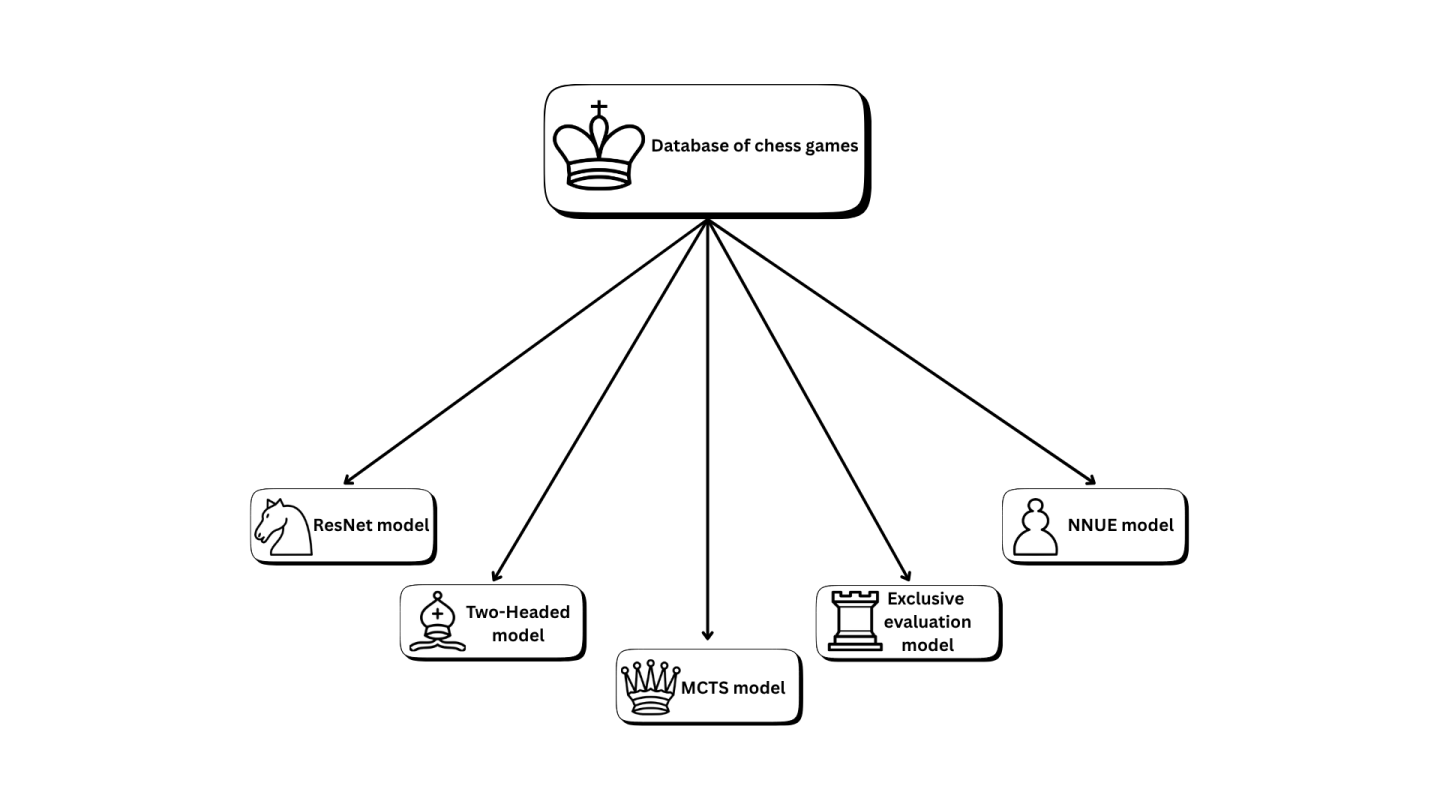
This project developed and evaluated several neural-network-based approaches for a Chess AI, experimenting with imitation learning from Stockfish, ResNet-based policy/value networks, a separate evaluation network paired with minimax search, Monte Carlo Tree Search (MCTS) with self-play, and finally an NNUE-style evaluator. Large-scale training data (Lichess database and self-play) was collected, data pipelines for FEN-encoded positions with Stockfish evaluations and best moves were implemented, and models were iteratively trained while measuring validation accuracy, evaluation-head mean-square error and practical playing strength. Key outcomes: (1) early two-headed and ResNet models showed limited improvement over random play; (2) an evaluation-only model combined with minimax produced the most promising playing behavior but was slow; (3) NNUE training produced unstable metrics in early epochs and requires further tuning and compute.
Full paper
For the complete technical details, methodology, and results, please refer to the full paper in Serbian.